I’ve seen a decent number of tribal peoples over
the years - from the jungles of Latin America (Maya, Kuna,
Piaroa, Yanomami,
Quechua… to name a few) out to the savannas of Africa (
Hamar, Mursi, Karo,
Maasai,
Tuareg… I could go on) and even
around various expanses of Asia (Banjara,
Kayan, Shan, Hmong, Yao...
ok, please stop me). The world surely has no shortage of aboriginal
communities, even if their individual populations are ironically under the
perpetual threat of decline. While the ethical question
of “ethno-tourism” continues to remain a controversial and heavily
debated topic on travel forums, I grew up possessing a natural curiosity
and strong fascination for indigenous societies that could only be satiated by
seeking them out. Though informative and
educational, books and documentaries would never provide me with the level
of understanding comparable to physically interacting with and learning
directly from tribal members about their unique ways of life.
In light of the many tribes I’ve visited, it sadly
dawned on me that I’ve never actually encountered the original
inhabitants of my very own country. The United States government
officially recognizes more than 500 distinct native groups,
none of whom I’ve ever crossed paths with. How is this possible? Indeed, recent history has
not been kind to Native Americans, whose once flourishing civilizations
have been devastated by disease, enslavement, eviction, and even
genocide at the hands of Spanish missionaries and
American settlers. More shamefully, it’s a story that’s still not mentioned as part of the standard secondary school US History
curriculum. Nevertheless, I've always had questions in the back of my mind concerning the state and views of these elusive minorities. I knew they’re certainly still around –
but where exactly?
My mission to find Native American people and learn
something about their current condition first started off locally. After
extensive research online, I came across a small inter-tribal gathering
taking place out in the Los Padres National Forest
near Santa Barbara, California. Originally starting out as a small, intra-tribal occasion for
feasting and ceremonial dances, the concept of the powwow has
transformed into an organized convention open to all tribes across North
America. It has become a celebratory opportunity for clans to meet, socialize,
sell handmade art and the raw materials for crafts, as well as participate in
competitions of dancing, singing, and drumming. Such a cultural event
was certainly worth making a three-hour journey for, hoping it would grant
me a chance to engage in some casual dialogue
with a people I’ve known only from outdated books and poorly-misrepresented films.
 |
| Members from many different tribes dancing around the circular arena to the beat of thunder drums |
 |
| A Chippewa Cree elder from Montana |
 |
| One of the Great Plains natives |
My anthropological senses tingled with excitement
as a colorful whirlwind of natives in full-feathered regalia orbited
around a dirt arena. Like the cracking boom of thunder, massive drums
were communally struck by circles of men from the
Northern and Southern Cree, their shrill ululating singing evoking the
image of ax-wielding war parties racing across the Great Plains. I started
conversing with a Navajo woman standing majestically in a colorful
shawl, her hair woven into two archetypal black braids with
a single erect feather at her apex.
“That’s my son on the far side of the circle. He’s
competing for the Fancy Dance. Watch his footwork as the drum gets
faster. When it stops, he’ll strike a pose!”
Like any mother, she was proud to showcase the skills of her son, performing a dance that isn't even traditional to the Navajo people but rather to the tribes of the Midwest. It made me consider how a wave of Pan-Indianism over the last century has brought very different and often distant tribes together to form a unified indigenous identity built upon shared cultural practices. At only 1.5% of the US population, it seemed logical that Native Americans from all over the continent would find strength through the unity embodied by the powwow. Even as an outsider myself, I began to feel the power of the circular arena as it drew people from as far as central Canada and Mexico closer to its pulsating center.
 |
| The Navajo woman's son performing the fast-paced and visually-stunning Fancy Dance |
The regal Navajo woman could sense my delight, which in turn delighted her.
“I’m pleased you’ve come all this way to see our
traditional dancing. You’re most welcomed to join us in a week for another
gathering near the San Manuel reservation. These competitions tour
around the country all summer. We’re like a bunch
of traveling circus freaks!”
The hosts of the Los Padres powwow were from the Chumash tribe, whose people have lived along the California coast for millennia. I came across one of its members, a ruggedly handsome man sporting a coyote pelt headdress and leather loincloth decorated with owl feathers. Intimidating as he looked, I eventually gained the courage to approach him.
“I've always been curious. What’s your view on having visitors, particularly
white people, coming to your cultural events and watching sacred dances that had long been performed for native eyes only?”
I tried to state my question delicately, particularly in remembering my own status as a visitor. Taking a bite out of my fry bread, I was fixated.
“History has not given our people much reason to
trust outsiders. It used to be illegal to gather and dance like this only a hundred years ago. At first I didn't know how I felt, but now I want outsiders to see this. I really do. They need to
know that we still exist and that our heritage is strong, rich, and
ancient.”
Thrilled from additional conversations with members of the Lakota and
Sioux, I followed up on the Navajo woman's offer and went to the second
gathering a week later. It felt delightfully strange suddenly running
into so many native "friends".
 |
| The Chumash man I briefly interviewed |
 |
| Other Chumash tribal members in traditional clothes |
 |
| Woman performing the Shawl Dance |
Checking the powwow off my list, I later realized that my chances of coming across whole native communities would likely fair better outside of over-developed, over-populated California. Growing up with a plethora of archaeology books as a child, I'd always read stories about the mystical treasures of the American Southwest, from enigmatic petroglyphs on canyon walls to lost stone cities built into hidden cliffs. The intricate folk arts of the Puebloan peoples had likewise always been admired by my family and I hadn't forgotten that Christmas holiday was soon approaching. On a whim, I decided to set out on my most distant solo weekend road trip to date: Arizona.
Aside from suddenly dropping in and staying with Andrew, a friend and doctoral student of anthropology at ASU who I happened to have met while
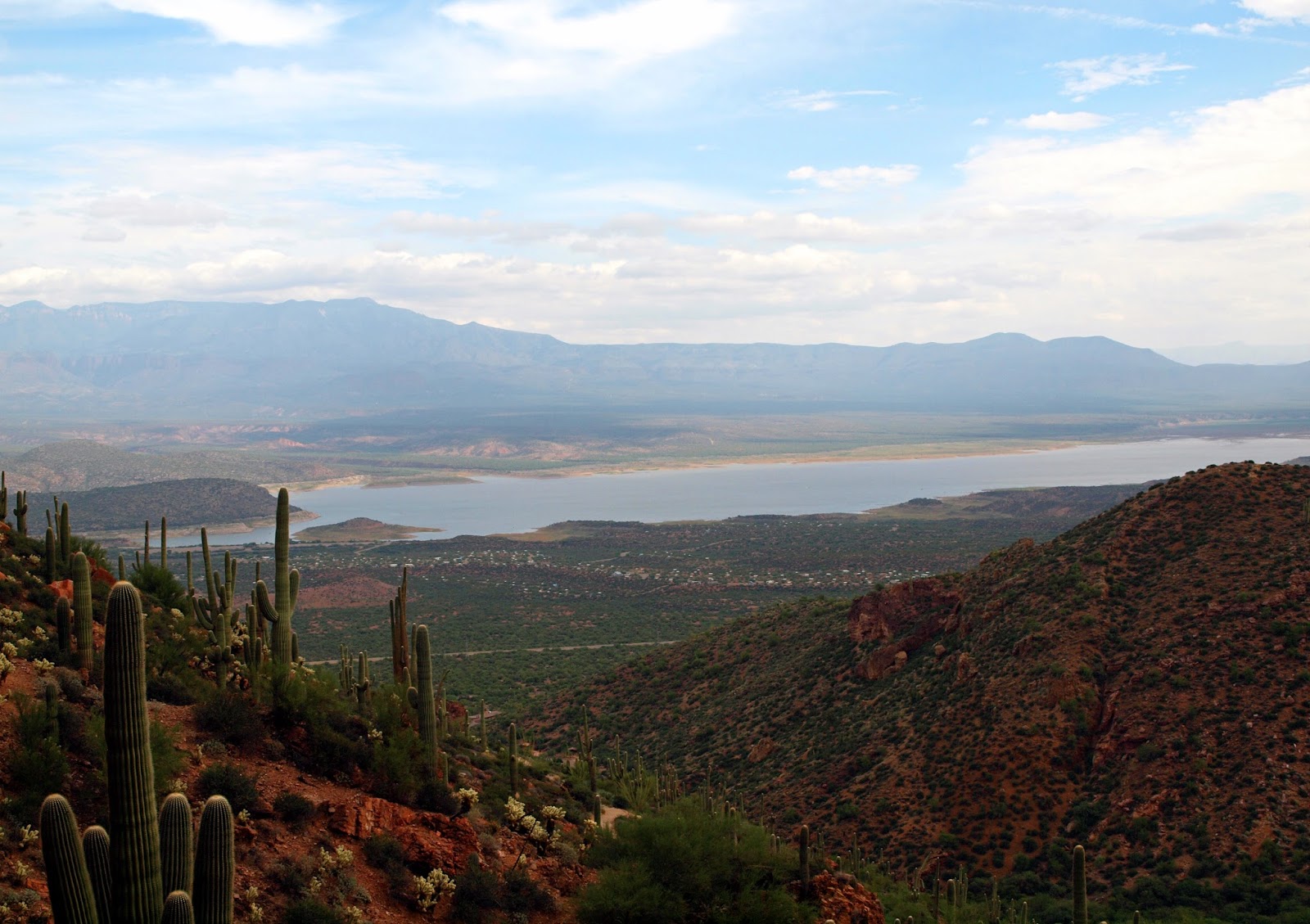
visiting the Kuna tribe in Panama, I had no set plans regarding my Arizonan adventure other than seeking people and pottery. Little did I know that, in exchange for nearly a thousand miles of driving in only two days, so much would be discovered and learned in such a brief time. I first headed east from Phoenix along winding highways that cut through the red rocky cliffs of the Superstition Mountains. After two hours, I found myself in the Tonto National Forest, which resembled more of an endless cactus garden than the kind of forest I was familiar with.
 |
| Visiting Andrew and sharing tribal encounter stories |
 |
| 20 foot high saguaro cacti shooting towards the sky in front of the sandstone butte |
 |
| View of the Tonto Basin and Roosevelt Lake |
 |
| Tonto National Monument, a 13th century Salado cliff dwelling hidden in a natural alcove |
It was up above, snugly hidden into the natural alcove of a sandstone facade where I gazed upon the 13th century ruins of a Salado cliff dwelling. I squealed with excitement, nearly walking straight into a massive saguaro cactus as I scrambled up the mountainside. It was no
Mesa Verde, but being my very first cliff dwelling, I was certainly in awe of the small adobe and stone structure that has remained perched above the valley for centuries. Waiting for me at the top was Ranger Miller, who greeted me with a charisma and energy comparable to that of
my best friend, Captain Matt. Standing among the stone walls of an ancient Native American site with such a vivacious and passionate character, it's no surprise that we talked for nearly forty minutes about the history and archaeology of indigenous peoples in the region. Ranger Miller waved his arms in large, epic sweeps across the open landscape.
"The Salado were not a single culture, but rather a diverse melting pot of natives from different ethnic and linguistic backgrounds that lived and worked together. This place was already an 'America' long before our notion of 'America', and a great mixed civilization occupied the entire Tonto Basin."
He stretched his hand out over the vast Tonto Basin below us, pointing in distant directions to where other large dwellings and villages had been discovered. The idea of an ancient indigenous melting pot gave me a cheesy grin, as I reflected back to the powwow in California and how I was fortunate to experience a contemporary tribal smorgasbord. Before departing, Ranger Miller jovially suggested that I visit the ruins of Besh-ba-gowah in the little town of Globe en route back to Phoenix.
 |
| Inside the ancient pueblo, which comprised of multistory stone and adobe structures |
 |
| View from within the alcove. Notice the grinding stone. |
 |
| Detail of the original adobe and wood construction |
 |
| Ancient Salado pot, gourd spoon, and stone axe |
 |
| Spent the morning discussing Ancestral Puebloan archaeology |
Arriving in Globe, I anticipated to see a small desert town of little significance with a couple streets and quiet rural atmosphere. What I surely didn't expect to see was a bustling town center filled with native people, ceremonial dancing, and artisan booths. I had coincidentally stumbled into the Apache Jii Festival, celebrating the performances, arts, and food of the Apache nation. And reminiscent to the environment of the Salado era, other neighboring tribes including the Navajo, Hopi, Zuni, and Pueblo peoples also joined in on the festivities to create a living indigenous melting pot right before my very eyes.
 |
| Performing the Hoop Dance, which involves literally jumping through hoops and making abstract shapes with them |
 |
| The Apache Crown Dance, invoking and imitating the spirits of the mountains |
After watching the Apache crown dancers, whose playful movements aim to emulate the frolicking of mischievous mountain spirits, I walked along the streets to look at amazing works of tribal art and speak directly to the artisans keeping such traditions alive. A young Hopi man in his early twenties caught my attention as he sat at his small little table, carving away at little logs with nothing but a pocketknife and a small chisel. He was meticulously making authentic Kachina dolls in the old style, using the sacred cottonwood root as the main medium for the abstract spirit effigies. He captivated me with his story.
“I watched my uncle carving these gods when I was little and realized
that I also wanted to learn. I’ve tried getting other friends to join me, but they don't always care. Sometimes I feel like it’s all on just my shoulders to keep our dying
ways alive. It’s hard work, but it gives me
honor and purpose.”
We discussed the beauty and challenges of maintaining traditions in a rapidly globalizing world. I admired him even more for his commitment at such a young age towards preserving his culture, rather than slipping into despair and alcoholism that frequently infects disadvantaged native boys. He explained to me the magic of Kachina dolls and the pantheon of natural spirits they represent.
“We all still follow the old religion. The Spanish
tried to give us their God, but we already got our own – and there’s a
lot, man! We don’t need Christianity and churches because our gods are
everywhere with us, in the earth and sky, in
the plants and animals. All things have its own sacred spirit that deserves respect.”
We talked for nearly half an hour. It amazed me to see how a young, humble woodcarver was capable of possessing a spiritual profundity and appreciation for life more advanced than many of my privileged friends back at home. I knew at that moment that if I was going to come home with an authentic Hopi "spirit", it wouldn't be from a souvenir shop or a fancy Indian art gallery back in Phoenix. It was going to be straight from the hands of this native kid, right on the street, at a native cultural festival in historic Apache territory.
 |
| The young Kachina carver demonstrating his art |
As I made my rounds, I came across a Hopi-Zuni couple selling exquisite handwoven baskets. The woman had the roundest, most jovial face I've seen since my time in Mongolia. She playfully insisted that I needed a nice genuine yucca fiber basket to carry my newly-acquired Kachina. I instantly felt compelled to chat.
“What’s it like living on a reservation? Aren’t
they considered autonomous areas by the government and does living there
have benefits?”
Chucking uncontrollably and looking over to her smiling husband, she was clearly amused by my questions, likely not the typical inquiries made by potential customers.
“Even though we can make our own laws, life on the
reservations can be a challenge sometimes, especially if your tribe is
small and your village is poor. But nothing can be more rich than
the sense of community and shared traditions
you gain by staying with your people. That, and we also don’t have to pay
state tax. That’s definitely a perk when you buy a new car and have it shipped!”
We talked for 15 minutes about Native American everyday living, after which I walked away with a wonderful little basket. It felt satisfying to directly support an indigenous artist who provided not only a beautiful and authentic piece, but a wonderful conversation and story that will forever accompany it.
“Please come visit us on the Hopi reservation! We live on top of the mesas [elevated sandstone plateaus] and still have our colorful Kachina dances during
village festival days. We don’t permit photography out of respect for our community's personal privacy, but you're still absolutely welcomed.
We’ll even bake bread for you, too!”
 |
| Buying native Southwest art and gifts directly from the artists in the small town festival |
My final stop was a stall selling intricately painted Towa pottery. Beside the collection of handmade vases, all painstakingly made using the archaic coil method and decorated with complex geometric patterns, large lumps of clay oven baked bread were quickly being sold. I gently interrupted two middle-aged sisters chatting in a beautifully incomprehensible language beside an old grandmother who spoke no English at all.
“I’ve come all the way from Los Angeles in search of native people. I feel like none of you guys are left!”
The stall erupted with laughter at my sincerely honest exclamation, which they apparently found to be rather adorable.
“Yeah, it’s been a rough couple hundred years, but we’re
all still here. We’re not going anywhere, either. And unlike the movies,
we’re pretty darn friendly. We won’t bite!”
The sisters looked at each other, letting out a giant guffaw that also infected the neighboring Navajo stall with laughter. We talked more about their particular culture, an obscure one based over in neighboring New Mexico that I had never even heard of before meeting them.
“Out in Jemez Pueblo, we speak a language that no other people speak anywhere else. We still live in our adobe
homes stacked one on top of another. Some people even live the old way, without
running water or electricity. It's okay, I guess. When you live by the sun, you tend to go to bed kinda early, haha.”
The stereotypical portrayal of Native Americans as being a stoic, fierce, and somewhat cold race was completely debunked by the smiles, laughter, and witticisms of the people I spoke with that entire day. As a result of their limited presence in mainstream American society, it's easy to envision them as being mythical and secretive. But for the most part, I came to the realization that Native American people are quite open and really not that different from the rest of us, facing the same ease and challenges that accompany everyday life for all citizens. Out in the middle of rural Arizona and hundreds of miles from home, it was such a pleasantly surreal Saturday afternoon spent at an outdoor native marketplace among strangers who could effortlessly be transformed into friends. All it took was a little respect mixed with a lot of interest. I also walked away with a beautiful ceramic pot.
 |
| The rugged cliffs and buttes of the Superstition Mountains |
 |
| Gold Canyon during a brief rain and lightning storm |
Before journeying back to the mundane world of strip malls and cultural indifference, I heeded the words of a Navajo petroglyph artist who recommended a special place to see large concentrations of ancient rock art. Making a full circle back towards the Superstition Mountains, I pulled off the highway and headed towards a large butte overlooking the vast, flat landscape around Gold Canyon. After getting lost, I found the trailhead and set off over a rocky path up towards a gully filled with boulders. Caught in a brief desert downpour, it felt refreshing to soak in the cool heavy rain and inhale the moist earthy aroma of wet sandstone. A bolt of lightning flashed across the expanse of the desert sky, followed by a low rumble echoing off the cliff face. I thought about what the Kachina carver told me and felt that the spirits of the mountain were home, probably welcoming me to their sacred space.
It was a sacred space, indeed. High in the gorge, natural rock pools had filled with water from the downpour and dry vegetation had sprung to life again through beautiful shades of green interspersed with vibrant hues from wild flowers. I snaked my way through the boulders, turned around a narrow bend, and came face-to-face with a massive stone edifice covered in innumerable 900-year-old Hohokam petroglyphs. Carefully scaling the precarious cliff side, I found more and more pictographs around every corner and in every crevasse. I felt as if I had wound up in a prehistoric art gallery filled with etched images of wild sheep, coyotes, lizards, anthropomorphic beings, star signs, and abstract geometric patterns. Having the entire hidden canyon to myself, I was completely overcome by the mystique and sanctity of a place that clearly possessed spiritual significance to the ancient ancestors of those whom I met earlier that day. I cleansed my face and hands in one of the natural pools, imagining the purity of the place washing away my stress and negativity. It was the perfect conclusion to a meandering journey in search of native America.
 |
| Standing beneath the great stone petroglyph slab showing herds of grazing animals |
 |
| Abstract designs of unknown meaning |
 |
| Lizard men |
 |
| Man on top of a coyote or dog |
 |
| A long-horned wild sheep |
 |
| Star signs and organic shapes of unknown meaning |
 |
| Looking down into Gold Canyon |
 |
| Ancient Hohokam rock shelter in the valley |
 |
| The sacred pool beneath the wall of petroglyphs, an oasis giving life to an otherwise deathly dry terrain |
Spending time with some of America's last vestiges of a real indigenous communities was eye-opening, informative, and also quite entertaining. It returned a sense of exoticism to a country that I have consistently been overlooking while on my annual search for unique historical locations and cultural experiences. I learned that Native Americans still persist, that they are just as unique and worthy of admiration as the other tribal peoples I've come across during my travels. As long as personal spaces are respected and
cultural boundaries are observed, native people throughout the world can be exceedingly
welcoming and proud to share their customs with those
who have strong interest in their preservation. Treating people as people, rather than
creatures simply to be gawked at, stereotyped, or exploited, can yield
some surprisingly meaningful moments of genuine human connection.